
What Is a Broker? Complete Beginner’s Business Guide for 2026
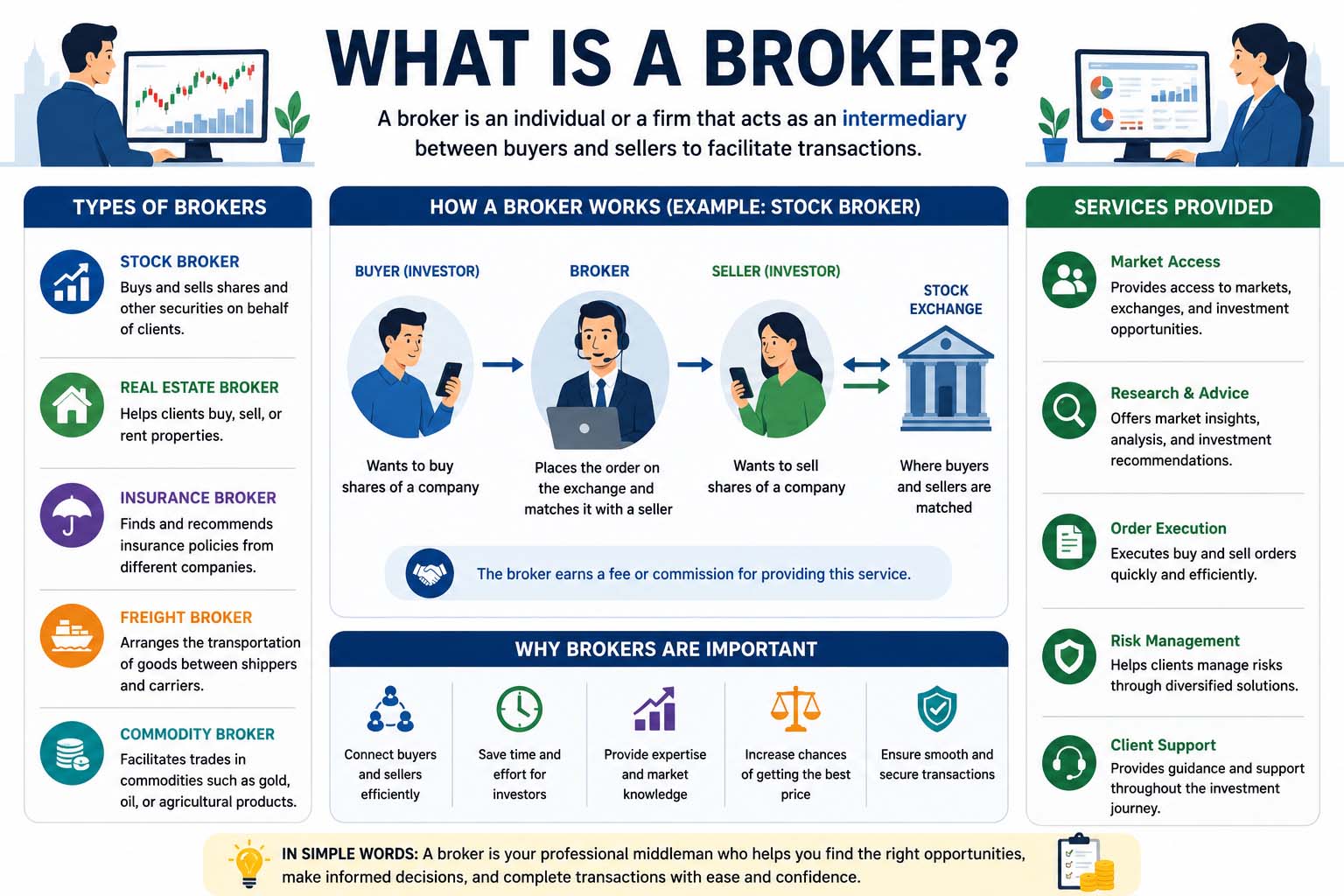
Understanding what is a broker starts with a simple definition: a broker is a professional or company that helps connect parties and arrange transactions. Brokers work in several industries, including real estate, finance, transportation, insurance, and mortgage lending.
Instead of directly selling their own products, brokers often act as intermediaries. They help clients compare options, communicate with other parties, negotiate terms, and complete transactions.
For example, a real estate broker may help someone purchase a house, while a freight broker connects a business with a transportation carrier.
However, a broker’s exact responsibilities depend on the industry, applicable regulations, and services offered.
Understanding the difference between a broker and a seller is also useful. For instance, What Is a Merchant explains the role of businesses and individuals that sell goods or services.
This guide covers how brokers work, their different types, payment structures, advantages, disadvantages, and the steps involved in choosing one.
How Does a Broker Work?
A broker helps two parties find each other and complete a transaction.
Depending on the industry, those parties might include:
- A homebuyer and property seller
- A borrower and mortgage lender
- A shipping company and freight carrier
- An investor and securities market
- An insurance customer and insurer
- A business buyer and business owner
For example, someone searching for a home loan may contact a mortgage broker instead of approaching several lenders individually.
The broker can then compare available loan products and help the borrower understand the application process.
However, brokers do not all provide the same services. Some primarily arrange introductions, while others handle negotiations, documentation, or ongoing client support.
How Brokers Earn Money
Brokers commonly receive payment through commissions, service fees, or transaction-based compensation.
For example, a real estate broker may receive a commission when a property sale closes.
Meanwhile, a mortgage broker may receive compensation from a lender, borrower, or another permitted arrangement.
Therefore, clients should understand the payment structure before agreeing to use brokerage services.
Why Brokers Are Important in Business
Brokers help businesses and consumers navigate markets that may involve complicated requirements or multiple service providers.
As a result, they can reduce the time clients spend researching options and coordinating transactions.
Common benefits include:
- Industry knowledge
- Access to professional networks
- Market research
- Negotiation assistance
- Administrative support
- Guidance through unfamiliar procedures
For example, a business owner arranging transportation may struggle to identify suitable carriers without industry contacts.
A freight broker can help locate transportation providers and coordinate shipment requirements.
In addition, Tips for Networking Events offers ideas for developing the professional relationships that support brokerage businesses.
However, professional assistance does not eliminate every financial or contractual risk. Clients should still review agreements and make informed decisions.
What Is a Real Estate Broker?
A real estate broker is a licensed professional who helps clients buy, sell, or rent property.
In many U.S. jurisdictions, brokers complete additional education, experience, or licensing requirements beyond those required for real estate sales agents.
However, the exact rules vary by location.
Real estate brokers may handle:
- Property listings
- Buyer and seller communication
- Price negotiations
- Contract coordination
- Property marketing
- Transaction documentation
- Supervision of real estate agents
Some brokers operate independent real estate businesses, while others manage brokerage offices or work with larger companies.
For example, a property seller may hire a broker to market a home, coordinate showings, and negotiate with potential buyers.
Market conditions also influence these transactions. Therefore, understanding Is the Housing Market Going to Crash may provide additional context about housing-market concerns.
Real Estate Broker vs Real Estate Agent
Although people sometimes use these terms interchangeably, they can represent different licensing levels.
| Feature | Real Estate Broker | Real Estate Agent |
|---|---|---|
| Licensing | Typically requires additional qualifications | Requires the applicable agent or salesperson license |
| Independent business | May operate independently where permitted | Often works under a supervising broker |
| Agent supervision | May supervise agents | Usually does not supervise other agents |
| Main role | Manages or facilitates property transactions | Assists clients with property transactions |
For example, a real estate agent may work under the supervision of a licensed broker.
Meanwhile, a qualified broker may operate an independent brokerage business.
However, specific licensing structures differ across countries and jurisdictions.
What Is a Mortgage Broker?
A mortgage broker helps borrowers explore home financing options from lenders.
Unlike a direct mortgage lender, a mortgage broker generally does not provide the loan funds.
Instead, the broker acts as an intermediary between the borrower and potential lenders.
Mortgage brokers may help clients:
- Compare available loan products
- Understand interest rates
- Review lending requirements
- Prepare application documents
- Communicate with lenders
- Evaluate loan terms and costs
For example, a first-time homebuyer may find it difficult to compare mortgage offers from different financial institutions.
A mortgage broker can help explain the differences between available products.
However, borrowers should still review loan terms carefully and compare the full cost of borrowing.
Benefits of Using a Mortgage Broker
Access to lenders
Mortgage brokers may work with multiple lenders, allowing borrowers to explore several financing options through one contact.
Loan comparisons
They can help clients compare interest rates, repayment terms, and applicable fees.
Administrative assistance
Brokers often help borrowers organize documents and communicate with lenders.
Guidance for beginners
First-time buyers may benefit from explanations of unfamiliar mortgage terminology.
However, a broker cannot guarantee loan approval. Lenders make approval decisions based on their own underwriting requirements.
What Is a Freight Broker?
A freight broker connects businesses that need to transport goods with carriers that provide transportation services.
Freight brokerage plays an important role in logistics and supply chain management.
For example, a manufacturer may need to ship products from a warehouse to a distribution center.
Instead of contacting trucking companies individually, the manufacturer may work with a freight broker to arrange transportation.
Freight brokers commonly coordinate:
- Carrier selection
- Shipment requirements
- Transportation pricing
- Pickup and delivery arrangements
- Communication between parties
- Shipment documentation
Although freight brokers arrange transportation, they generally do not physically transport the goods themselves.
Businesses interested in transportation operations can also review How to Start a Trucking Company to understand the planning involved in operating a trucking business.
How Freight Brokers Make Money
Freight brokers commonly earn revenue from the difference between the amount charged to a shipping customer and the amount paid to a carrier.
For example:
- A customer pays $2,000 for an arranged shipment.
- The freight broker agrees to pay the carrier $1,700.
- The remaining $300 represents the broker’s gross margin.
However, this amount is not necessarily net profit because the broker may have additional operating expenses.
Therefore, freight brokerage profitability depends on pricing, operating costs, shipment volume, and business relationships.
Different Types of Brokers
Brokerage services extend beyond property sales and transportation.
Several common types operate in specialized industries.
Stock Brokers
Stock brokers help investors buy and sell securities such as stocks and exchange-traded funds.
Depending on the service model, they may offer trading platforms, transaction execution, research, or investment-related services.
In the United States, securities broker-dealers operate under specific regulatory requirements.
For example, the U.S. Securities and Exchange Commission’s broker-dealer guidance provides information about this regulated industry.
Insurance Brokers
Insurance brokers help individuals and businesses explore insurance coverage.
They may compare policies from different insurers and explain coverage terms.
However, available products, licensing rules, and compensation arrangements depend on the market.
Business Brokers
Business brokers assist with the purchase or sale of businesses.
For example, a business owner preparing to sell a company may hire a broker to identify potential buyers.
The broker may also help coordinate negotiations and transaction documentation.
Real Estate Brokers
These professionals assist with property transactions, including buying, selling, and renting real estate.
Depending on their licensing, they may also supervise agents or operate brokerage businesses.
Mortgage Brokers
Mortgage brokers help borrowers compare home financing products from lenders.
Their role focuses on arranging financing rather than directly providing loan funds.
Freight Brokers
Freight brokers connect shipping customers with transportation carriers.
As a result, they help coordinate commercial shipments without necessarily owning transportation equipment.
Real-World Example of a Broker
Imagine someone wants to purchase a home but has limited experience with property transactions.
A real estate broker may help the buyer:
- Identify suitable properties.
- Arrange property viewings.
- Compare asking prices.
- Prepare and negotiate an offer.
- Coordinate communication with the seller.
- Understand transaction documents.
- Work with other professionals during closing.
For example, the buyer may find a property listed at $350,000.
After reviewing comparable properties, the broker may help the buyer prepare an offer based on local market conditions.
However, the final purchase price depends on negotiations and agreement between the parties.
Therefore, a broker provides assistance and expertise rather than guaranteeing a particular outcome.
How to Become a Broker
The process of becoming a broker depends on the industry and location.
However, several general steps apply across many brokerage careers.
Step 1: Choose an Industry
First, decide which brokerage field matches your interests.
Common options include real estate, finance, insurance, mortgage lending, and freight transportation.
Each industry requires different knowledge and skills.
Step 2: Understand Licensing Requirements
Next, research the applicable legal and professional requirements.
For example, real estate and securities brokerage often involve formal licensing or registration.
However, the exact qualifications vary by jurisdiction.
Step 3: Gain Industry Experience
Practical experience helps aspiring brokers understand client needs, market conditions, and transaction procedures.
For instance, some real estate professionals work as agents before qualifying for broker licenses.
Step 4: Develop Communication Skills
Brokers regularly communicate with clients, service providers, and other professionals.
Therefore, negotiation, listening, and problem-solving skills are valuable.
Step 5: Build Professional Relationships
Industry relationships can help brokers identify opportunities and serve clients effectively.
However, professional networking should support ethical business practices rather than replace proper qualifications.
Step 6: Establish a Business Model
Finally, brokers planning to operate independently need to consider operating costs, marketing, compliance, and customer service.
Some professionals join established brokerage firms before starting their own businesses.
Business Strategy Tips for Brokers
Brokerage businesses depend heavily on trust, service quality, and professional relationships.
However, strong technical knowledge alone may not attract enough clients.
Successful brokers often focus on several business practices.
Build a Professional Reputation
Clear communication and reliable service help clients understand what to expect.
For example, explaining fees before a transaction can reduce misunderstandings.
Develop Industry Knowledge
Markets change over time. Therefore, brokers should stay informed about relevant regulations, customer expectations, and industry developments.
Use Customer-Focused Sales Techniques
Brokers benefit from understanding client needs before recommending options.
For instance, What Is Consultative Selling explains an approach that emphasizes customer needs and informed conversations.
Improve Online Visibility
Websites, professional profiles, and useful educational content can help potential clients learn about brokerage services.
However, marketing claims should remain accurate and consistent with applicable professional rules.
Maintain Strong Relationships
Long-term relationships may support referrals and repeat business.
As a result, brokers should prioritize clear expectations, reliable communication, and consistent service.
Technology and the Future of Brokerage
Technology continues changing how brokerage businesses operate.
Today, many firms use digital tools to manage transactions and communicate with clients.
Common examples include:
- Customer relationship management software
- Digital document systems
- Online appointment scheduling
- Automated reporting tools
- Virtual property tours
- Market research platforms
- AI-assisted administrative tools
For example, a real estate brokerage may use online scheduling and digital documents to simplify client communication.
Meanwhile, a freight brokerage may use software to coordinate shipments and monitor transportation updates.
However, automated tools do not eliminate the need for professional judgment.
Clients still benefit from clear explanations, appropriate oversight, and reliable service.
Advantages and Disadvantages of Using Brokers
Working with a broker can provide meaningful benefits. However, clients should also understand the possible limitations.
| Advantages | Disadvantages |
|---|---|
| Saves research and coordination time | May involve commissions or service fees |
| Provides industry knowledge | Service quality varies |
| Offers access to professional networks | Available options may be limited |
| Supports negotiations | Potential conflicts of interest |
| Helps manage transaction details | Clients still need to review agreements |
For example, a mortgage broker may simplify comparisons between lenders.
However, the broker may not work with every lender in the market.
Therefore, clients should ask about available options and compensation arrangements before making decisions.
Common Mistakes When Choosing a Broker
Selecting the wrong broker can create unnecessary costs or complications.
However, careful research can help reduce avoidable problems.
Ignoring Licensing Requirements
Some brokerage services require professional licenses or registrations.
Therefore, verify credentials with the relevant regulator or licensing authority when applicable.
Focusing Only on Fees
A low commission does not always mean better service.
Instead, compare qualifications, experience, communication, and the scope of services.
Failing to Understand Compensation
Brokers may receive payments from different parties depending on the transaction.
As a result, clients should ask how the broker earns money and whether compensation creates potential conflicts.
Overlooking Industry Experience
Experience in one brokerage field does not automatically translate to expertise in another.
For example, freight brokerage and mortgage brokerage require different knowledge.
Skipping Contract Reviews
Clients should read agreements before signing.
In particular, review fees, responsibilities, cancellation terms, and any exclusivity requirements.
Why Brokers Remain Important
Online platforms allow consumers and businesses to access more information independently.
However, many transactions still involve specialized knowledge, negotiations, and complex requirements.
For example, buying a property may involve financing, contracts, inspections, and coordination among several parties.
Similarly, arranging commercial transportation can require carrier selection, scheduling, and documentation.
Therefore, brokers can remain valuable when their expertise helps clients manage these processes.
Nevertheless, the usefulness of a broker depends on the client’s needs, the transaction’s complexity, and the quality of the services provided.
Frequently Asked Questions About Brokers
What Is a Broker?
A broker is a professional or company that helps arrange transactions between parties. Depending on the industry, brokers may provide research, negotiation assistance, or administrative support.
What Is a Real Estate Broker?
A real estate broker helps clients buy, sell, or rent property. Depending on local licensing rules, a broker may also supervise agents or operate an independent brokerage business.
What Is a Mortgage Broker?
A mortgage broker helps borrowers explore loan options from lenders. However, the broker generally does not provide the loan funds directly.
What Is a Freight Broker?
A freight broker connects businesses that need shipping services with transportation carriers.
Do Brokers Make Money Through Commissions?
Many brokers earn commissions, service fees, or transaction-based payments. However, compensation structures vary by industry and agreement.
Is a Broker the Same as an Agent?
Not always. The distinction depends on the industry and jurisdiction. For example, real estate brokers may hold additional qualifications and supervisory authority compared with real estate sales agents.
Can You Complete Transactions Without a Broker?
In some industries and situations, yes. However, legal requirements and practical considerations vary. Clients should evaluate whether professional assistance would provide useful value.
Conclusion
Understanding what is a broker helps explain how professionals facilitate transactions across real estate, mortgage lending, freight transportation, insurance, and financial markets.
Brokers may connect buyers and sellers, compare options, coordinate documentation, and support negotiations. However, their responsibilities and compensation structures vary by industry.
Therefore, anyone considering brokerage services should review qualifications, fees, experience, and contractual terms before making a decision.
A suitable broker can simplify a complicated process while helping clients make more informed choices.